Safe Schools Africa Expands Child Road Safety Across Côte d’Ivoire and Senegal
09 December 2025
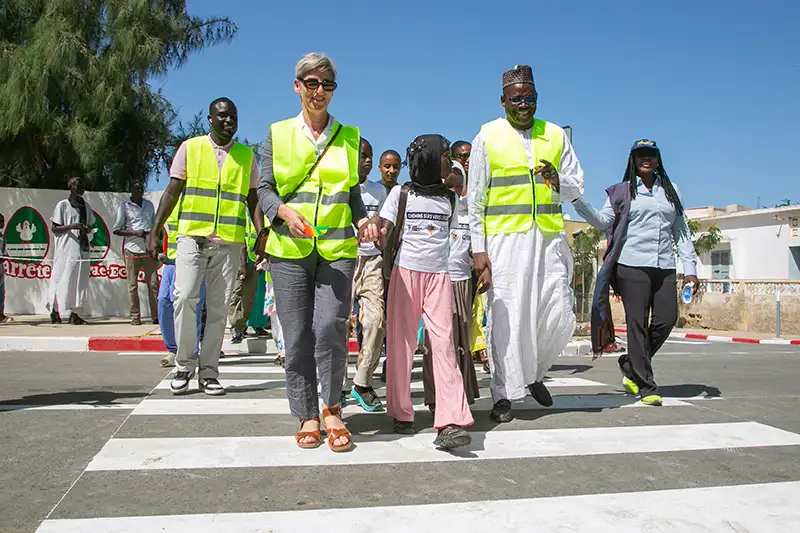
Child pedestrian safety is being improved through planning, community engagement, and construction in Bouaké, Côte d’Ivoire and Saint-Louis, Senegal as part of NGO Amend’s Safe Schools Africa programme, funded by the Agence Française de Développement (AFD) and the FIA Foundation.
Bouaké, Côte d’Ivoire’s second-largest city with nearly a million residents, is experiencing rapid urban growth and rising traffic volumes. Unsafe crossings, speeding vehicles, and minimal pedestrian infrastructure have made walking to school hazardous for thousands of children. Under the Safe Schools Africa programme and aligned with Bouaké’s Sustainable Urban Mobility Plan (SUMP), four primary schools—EPP Ville Nord, Groupe Scolaire Aboliba, Groupe Scolaire Annexe, and Groupe Scolaire TSF Bassa—received targeted infrastructure improvements between January and August 2025. These schools, which together serve more than 5,700 children, were selected due to their high-risk profiles and troubling injury records.
Amend led the implementation in close collaboration with the City of Bouaké’s Urban Mobility Department, OJISER, OSER, and the Research and Development Institute (IRD). The interventions followed the evidence-based School Area Road Safety Assessments and Improvements (SARSAI) model, rigorously evaluated and shown to significantly reduce child traffic injuries and deaths where applied. These improvements also benefit the broader community, making everyday travel safer for thousands of residents.
Across the four schools, the improvements included speed humps, raised and standard zebra crossings, extended and newly constructed footpaths, safer school entrances, reconfigured school walls, safety platforms, a new bus stop, and clear signage. These upgrades were informed by injury data, on-site assessments, and extensive consultations with teachers, children, parents, vendors, and city officials.
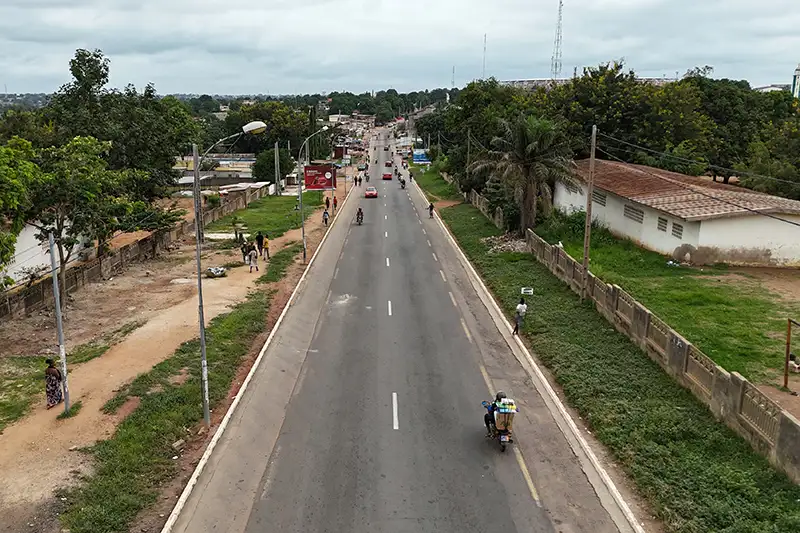

Preschool and Primary Education Inspector Korotoum Karamoko described how danger had driven families away from Ville Nord: “Parents preferred to send their children to a crowded school rather than this one because of the speed of the vehicles. Thank you, because next year will be different and the school will be able to revive.”
That sentiment was echoed by fifth-grade student Abdramane Yéo during the ribbon-cutting ceremony: “Before, my classmates and I risked our lives crossing the road. Now we feel much safer.”
In Saint-Louis, Senegal, similar work was completed at Nalla Ndiaye and François Mbaye Salzmann Primary Schools. Over the past several years, at least six children have been injured in traffic near these schools. Safe Schools Africa interventions - designed with local communities and the Senegalese government - now protect more than 1,300 students by separating children from traffic and reducing vehicle speeds. The measures implemented mirror the same SARSAI principles: evidence-led, community-driven, and centred on the safety of children.
Together, the recent interventions in Bouaké and Saint-Louis demonstrate the power of partnership and evidence-based design in rapidly growing African cities. The work in Bouaké, in particular, is informing larger infrastructure initiatives co-financed by AFD and the European Union and shaping long-term mobility planning. Across both countries, these projects reaffirm that simple, well-targeted infrastructure—speed humps, safe pathways, raised crossings, clearly marked school entrances—can save lives immediately.
Safe Schools Africa will continue scaling these proven solutions across Côte d’Ivoire, Senegal, and the wider continent, so every child can have a safe journey to school.
Images credit Amend.